
Class 10 - Science
Chapter 7 - Control and Coordination
Top Block 1
Question : 1 What is the function of receptors in our body?
Answer :
Receptors are usually located in our sense organs, such as the inner ear, the nose, the tongue, and so on. So gustatory receptors will detect taste while olfactory receptors will detect smell.
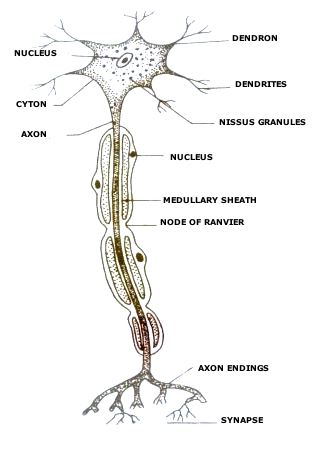
Question : 2 Draw the structure of neuron and explain its function.
Answer :

Question : 3 How does phototropism occur in plants?
Answer :
Phototropism is a growth movement induced by a light stimulus. Growth towards a source of light is called positive phototropism, that away from the source is termed negative phototropism. The tips of shoots are usually positively, that of roots negatively phototropic. Charles Darwin and his son Francis discovered (in 1880) that the phototropic stimulus is detected at the tip of the plant. The Darwins used grass seedlings for some of their experiments. When grass seeds germinate, the primary leaf pierces the seed coverings and the soil while protected by the coleoptile, a hollow, cylindrical sheath that surrounds it. Once the seedling has grown above the surface, the coleoptile stops growing and the primary leaf pierces it.
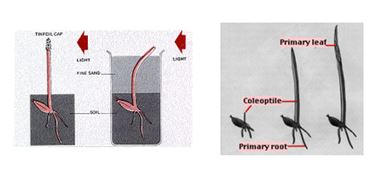
However, when they buried the plant in fine black sand so that only its tip was exposed, there was no interference with the tropism – the buried coleoptile bent in the direction of the light.
From these experiments, it seemed clear that
• The stimulus (light) was detected at one location (the tip)
• The response (bending) was carried out at another (the region of elongation).
• This implied that the tip was, in some way, communicating with the cells of the region of elongation.
Question : 4 How does chemical coordination occur in plants?
Answer :
It has been found that the growth of plants is regulated by certain chemical substances which are synthesized by the plants in very small amounts. These are known as plant hormones or phytohormones. They are the organic substances which either promote or inhibit growth. A phytohormones can be defined as a chemical substances which are produced naturally in plants and are capable of translocation and regulating one or more physiological processes when present in low concentration. Main categories of plant hormones are:
1. Auxins
2. Gibberellins
3. Cytokines
4. Ethylene
5. Abscisic acid
Auxins and Gibberellins stimulate cell elongations, cytokines stimulate cell division ethylene promotes transverse or isodiametric growth and abscisic acid is a growth inhibitor.
Question : 5 What is the need for a system of control and coordination in an organism?
Answer :
Co-ordination in this sense refers to the regulation or control of body activity. Plants need very little in the way of a control system. Since growth and reproduction are about the only things that are regulated, a rapid control system is not required and hormonal control is all they possess. Animals are continually moving through new environments that may pose all types of changes and threatening situations to the organism. This requires the rapid and precise control of a nervous system. Hormones regulate slower activities, such as growth, development and reproduction.
Question : 6 How are involuntary actions and reflex actions different from each other?
Answer :
All reflex actions are involuntary in nature but all involuntary actions are not reflexes as the beating of heart is an involuntary action but is not reflex action. Reflex actions are very quick but all involuntary actions may not be very fast as in heart beating. A reflex action may involve any muscle or a gland as we withdraw our hand on touching a hot object but all involuntary actions involve only smooth i.e., involuntary or cardiac muscles.
Reflex actions are at the level of spinal cord whereas the involuntary actions generally involve brain too.
Nerves and autonomous nervous system can increase or decrease the rate of involuntary actions but reflex actions can be controlled by great will only and are not usually controllable.
Reflex actions are done to meet emergencies where as an inv.action may or may not be for just meeting an emergency but may be a critical lie process as circulation of blood, swallowing of food, movement of food in food pipe, etc.
Multiple Choice Questions
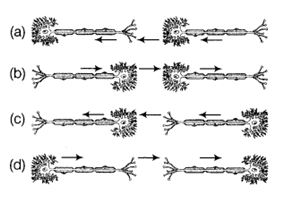
Question : 1. What is the correct direction of flow of electrical impulses? [NCERT Exemplar]
Mddle block 1
Answer :
(c) Direction of flow of electrical impulse.
Impulse → Dendrite → Cell body → Axon → Release of chemicals that cross synapse → Dendrite of next neuron.
Question : 2. Three directions in which nerve impulses can travel in the nervous system are listed below:
(i) Away from the central nervous system
(ii) Towards the central nervous system
(iii) Within the central nervous system
In which direction do impulses in sensory and relay (intermediate) neurons travel?
| Sensory Neuron | Relay Neuron | |
|---|---|---|
| a | (i) | (ii) |
| b | (i) | (iii) |
| c | (ii) | (i) |
| d | (ii) | (iii) |
Answer :
(d) Sensory neuron transmits impulses towards CNS, (i.e. brain and spinal cord) while, the relay neurons occur within the CNS and serve as links between other neurons.
Question : 3. In a nerve pathway, the following events take place in a coordinated order.
(i) Activation of muscle
(ii) Activation of receptor
(iii) Passage of impulses along a motor neuron
(iv) Passage of impulses along a sensory neuron
Read the events given and identify the correct order of these events from the table given below:
| First | ——→ | Last | ||
|---|---|---|---|---|
| a | (ii) | (iii) | (iv) | (i) |
| b | (ii) | (iv) | (iii) | (i) |
| c | (iv) | (i) | (iii) | (ii) |
| d | (iv) | (ii) | (i) | (iii) |
Answer :
(b) The sequence of events in a typical nerve pathway is receptor ——→ passage of impulse along sensory neuron ——→ passage of impulse along motor neuron ——→ activation of muscle (effector). Thus, the correct sequence is (ii), (iv), (iii) and (i).
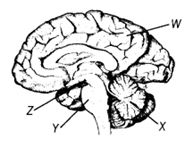
Question : 4. The diagram shows a section of the brain and different parts labelled as W, X, Y and Z.
| Balance | Heart Rate | Heart RateTemperature | |
|---|---|---|---|
| a | W | Z | X |
| b | X | Y | Z |
| c | Y | X | Z |
| d | Z | W | Y |
Answer :
(b) Out of the options given, the region X, (i.e. cerebellum) controls balance, region Y (i.e. medulla oblongata) controls heartbeat and region Z, (i.e. hypothalamus) controls temperature in human body.
Question : 5. Which of the following endocrine glands is unpaired? [NCERT Exemplar]
(a) Adrenal
(b) Testes
(b) Pituitary
(d) Ovary
Answer :
(c) There are two adrenal glands, one on top of each kidney that make adrenaline hormone. Testes are paired glands present in males and secrete male sex hormone. Pituitary gland is present just below the brain and is unpaired. It is also called master gland as it secretes a number of hormones. Ovaries are paired glands present in females and secrete female sex hormones.
Question : 6. Dramatic changes of body features associated with puberty are mainly because of secretion of [NCERT Exemplar]
(a) oestrogen from testes and testosterone from ovary
(b) oestrogen from adrenal gland and testosterone from pituitary gland
(c) testosterone from testes and oestrogen from ovary
(d) testosterone from thyroid gland and oestrogen from pituitary gland
Answer :
(c)
Additional Questions
Question : 1 What is a neuron?
Answer :
A neuron is a nerve cell that is the basic building block of the nervous system. Neurons are similar to other cells in the human body in a number of ways, but there is one key difference between neurons and other cells. Neurons are specialized to transmit information throughout the body.
These highly specialized nerve cells are responsible for communicating information in both chemical and electrical forms. There are also several different types of neurons responsible for different tasks in the human body.
Question : 2 Name any two types of tropism.
Answer :
The two types of tropism are phototropism and geotropism.
Question : 3 What is a phytohormone? Name any two phytohormones.
Answer :
Phytohormones are chemical substances, which are produced naturally in plants and are capable of translocation and regulating one or more physiological reactions when present in appropriate concentrations. The two phytohormones are auxins and gibberellins.
Question : 4 Mention the receptors for light and sound in animals.
Answer :
Photoreceptor is the receptor for light and phonoreceptor is the receptor for sound in animals.
Question : 5 How does control and coordination takes place in plants?
Answer :
Plants have a unique mechanism of controlling and coordinating its various physiological and biological processes. Plants respond to light, touch, gravitational force and other stimuli. Growth and movements in plants are regulated by both external and internal factors. The functions of control and coordination in plants are performed by chemical substances known as plant hormones or phytohormones.
Question : 6 Mention the names of various phytohormones.
Answer :
The various phytohormones are auxins, gibberellins, cytokines, abscises acid and ethylene.
Question : 7 Discuss phototropism.
Answer :
The movement of plants toward light is called phototropism.
Question : 8 Differentiate between tropic and nastic movements.
Answer :
Tropic movement:
The movement of a plant in the direction of stimulus.
Nastic movement:
The movements, which are neither towards nor away from the stimulus.
Question : 9 Draw the diagram of a neuron.
Answer :
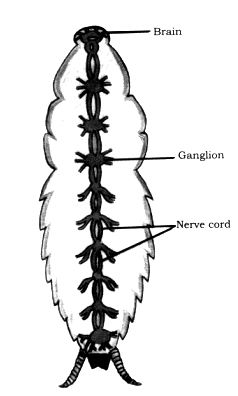
Question : 10 Draw a neat diagram of the nervous system in an insect.
Answer :
Question : 11 Describe the central nervous system in human beings.
Answer :
The central nervous system in human beings is highly developed. It consists of (i) brain and (ii) spinal cord. Brain is the highest coordinating centre in the body. It is protected by a bony box in the skull called the cranium. Brain is covered by three membranes, called meninges. The space between the membranes is filled by cerebrospinal fluid that protects the brain from mechanical shocks.
The brain is broadly divided into three regions (i) Fore brain (ii) Mid brain and (iii) Hind brain.
Each region of the brain consists of various centres. The fore brain includes cerebrum and olfactory lobes.The cerebrum is the most complex and specialized part of the brain. It consists of two cerebral hemispheres.The cerebrum has sensory areas where information is received from sense organs. Similarly, there is the motor area from where impulses are sent to the muscle or effectors organs. In the cerebrum, specific regions for each kind of stimulus and its response are located. Pairs of cranial nerves arise from the brain. The hind brain consists of three centres, cerebellum, pons and medulla oblongata. Medulla oblongata is the regulating centre for swallowing, coughing, sneezing and vomiting. The pons takes part in regulation of respiration. Coordination and the adjustment of movement and posture are under the control of cerebellum.
Spinal cord is a part of the central nervous system, which lies in the vertebral canal. It is a downward continuation of the medulla oblongata. In the spinal cord, the arrangement of white and grey matter is reverse of that of the brain. The grey matter containing cytons is the inner region and white matter containing myelinated axons is the outer. In the centre of the spinal cord runs a small central canal. This central canal, which runs the entire length of the spinal cord, is continuous with the ventricles of the brain. The spinal cord in transverse section has H-shaped structure because it has fissures on the ventral and the dorsal sides. The dorsal fissure almost reaches the gray matter while the anterior median fissure falls short of it. Spinal cord gives off 31 pairs of nerves.
Question : 12 Write the functions of any one part of the hind – brain.
Answer :
Cerebellum is the part of the hind – brain that controls and coordinates the movements of our body and helps in adjusting the posture. It functions even when the person is asleep.
Question : 13 What is the autonomic nervous system?
Answer :
The autonomic nervous system controls the involuntary action of the body. It mainly controls and integrates the functions of internal organs like heart, blood vessels, glands, smooth muscles and uterus in the body. The autonomic nervous system is subdivided into (i) sympathetic and (ii) parasympathetic system. The organs receive nerves from both sympathetic and parasympathetic nerve fibres. They have antagonistic effects on the organs if one is stimulatory, the other is inhibitory.
Question : 14 Define reflex action with suitable examples.
Answer :
When we suddenly withdraw our hands on pricking a pin, it is a reflex action. This type of sudden response to a stimulus is involuntary. A reflex action is defined as an unconscious and involuntary response of effectors to a stimulus. In reflex actions, a message from the receptors is relayed by sensory nerves to the spinal cord, which sends information for response via motor nerves to effectors. The pathway is called reflex arc. The simplest type of reflex action is knee-jerk reflex. In this case, while sitting with freely hanging legs, a strike below the knee cap kicks the leg forward. Other reflex actions are coughing, sneezing, yawning and blinking of eyes.
Question : 15 Name the hormones secreted by thyroid, parathyroid and pancreas.
Answer :
(i) Thyroid secretes thyroxin,
(ii) Parathyroid secretes calcitonin and
(iii) Pancreas secrete insulin and glucagon.
Question : 16 List the functions of testosterone and oestrogen.
Answer :
The functions of testosterone are the regulation of male accessory sex organs and secondary sexual characters like moustache, beard and voice.
The functions of oestrogen are the regulation of female accessory sex organs and secondary sexual characters like mammary glands, hair pattern and voice, and the maintenance of pregnancy.
Question : 17 Write name of three hormones secreted by the pituitary gland.
Answer :
The three hormones secreted from pituitary gland are
(i) growth hormone,
(ii) adrenocorticotrophic hormone and
(iii) follicle stimulating hormone (FSH).
Question : 18 Nervous and hormonal system together perform the function of control and coordination in human beings. Justify the statement.
Answer :
In humans, the nervous system is the most important, rather essential, system for regulation, control and coordination of body functions. It makes possible a range of adaptive responses to changes in the environment in the interests of the individuals. This system helps the individual to respond in a coordinated manner to environmental changes, to control various movements and to prolong the life by protecting the body against harmful stimuli. Coordination in humans is brought about by the secretions of endocrine glands. Endocrine glands are the ductless glands, which secrete the chemical substances called hormones directly into the blood. Any chemical substance, which is formed in the tissues of endocrine glands and are carried by the blood to other parts of the body for its specific actions is termed as a hormone. An organ, which responds to such a hormone, is known as the target organ. Hence, hormones and nervous system together perform the function of control and coordination in the human beings.
Question : 19 What is hydrotropism?
Answer :
Hydrotropism is a type of tropism, where the plant shows movement in response to water.
Question : 20 What is coordination?
Answer :
The organ system cannot work independently. They are linked in one way or the other. Working together of all these systems is called coordination.
Question : 21 Why is the response of a plant to a stimulus not observed immediately?
Answer :
The response of a plant to a stimulus not observed immediately because the plant shows its response very slowly.
Question : 22 What are hormones?
Answer :
Any chemical substance which is formed in the tissues of endocrine glands and are carried by the blood to other parts of the body for its specific actions is termed is hormone.
Question : 23 What are phytohormones?
Answer :
A phytohormones can be defined as chemical substances, which are produced naturally in plants and are capable of translocation and regulating one or more physiological processes when present in low concentration.
Question : 24 What are meanings? What are their functions? Name the fluid, which is filled in between meanings.
Answer :
The brain is surrounded by three membranes called meanings, which help to protect the brain. The space between the meanings is filled with cerebra spinal fluid, which protects the brain from mechanical shocks.
Question : 25 How does control and coordination occur in single-celled animals?
Answer :
The cytoplasm of the single-celled animal controls and coordinates the activities of the organism.
Question : 26 Name any two phytohormones, which are growth promoters.
Answer :
The two phytohormones, which are growth promoters are Auxins and Gibberellins.
Question : 27 Name any growth inhibiting phytohormone.
Answer :
Abscises acid is a growth inhibiting phytohormone.
Question : 28 What makes a stem bend towards sunlight?
Answer :
The chemical substance called plant hormone or phytohormone makes a stem bend towards sunlight.