
Class 10 - Science
Chapter 14 - Sources of Energy
Top Block 1
Question : 1 What is a good source of energy?
Answer :
A good source of energy would be one,
i) Which would do a large amount of work per unit volume or mass.
ii) Be easily accessible.
iii) Be easy to store and transport, and
iv) Perhaps most importantly, be economical.
Question : 2 What is a good fuel?
Answer :
A good fuel would be one,
i) Which is easily available.
ii) It should not produce too much of smoke.
iii) On burning should release less amount of heat.
Question : 3 If you could use any source of energy for heating your food, which one would you use and why?
Answer :
Solar energy can be used for heating food because it is easily available, it will not produce smoke and it will not release any amount of heat.
Question : 4 What are the disadvantages of fossil fuels?
Answer :
Fossil fuels are non-renewable. Burning of coal or petroleum products causes the air pollution. The oxides of carbon, nitrogen and sulphur that are released on burning fossil fuels are acid oxides. These lead to acid rain, which affects water and soil resources.
Question : 5 Why are we looking at alternate sources of energy?
Answer :
The fossil fuels are non-renewable sources of energy. So we need to conserve them. If we were to continue consuming these sources at such alarming rates, we would soon run out of energy. In order to avoid this, alternate sources of energy were explored.
Question : 6 How has the traditional use of wind and water energy been modified for our convenience?
Answer :
The wind possesses kinetic energy. This energy was harnessed by windmills in the past to do mechanical work. Today, wind energy is also used to generate electricity.
Another traditional source of energy was the kinetic energy of flowing water or the potential energy of water at a height. Hydropower plants convert the potential energy of falling water into electricity.
Question : 7 What kind of mirror – concave, convex or plane – would be best suited for use in a solar cooker? Why?
Answer :
Plane mirror would be best suited for use in a solar cooker. A plane mirror is used as a reflector. The reflector is used to increase the area over which the solar energy is collected so that more and more heat rays of the sun may enter the solar cooker.
Question : 8 What are the limitations of the energy that can be obtained from the oceans?
Answer :
The energy from the oceans can be obtained mainly in three forms,
a) Tidal energy
b) Ocean waves energy
c) Ocean thermal energy
The energy potential from sea is quite large, but efficient commercial exploitation is difficult.
Question : 9 What is geothermal energy?
Answer :
‘Geo’ means ‘earth’ and ‘thermal’ means ‘heat’. Thus the geothermal energy is the heat energy from the hot rock present inside the earth. This heat can be used as a source of energy to produce electricity.
Question : 10 What are the advantages of nuclear energy?
Answer :
The advantages of nuclear energy is as follows,
(a) It generates electricity.
(b) Disease like cancer can be treated.
(c) It helps for the improvement in the agriculture and industry.
Question : 11 Can any source of energy be pollution-free? Why or why not?
Answer :
Yes, Solar energy does not cause any pollution. Solar cells make use of the ‘everlasting solar energy’ and their use does not produce any environmental pollution.
Question : 12 Hydrogen has been used as a rocket fuel. Would you consider it a cleaner fuel than CNG? Why or why not?
Answer :
Yes, hydrogen is a cleaner fuel than CNG because of its very high colorific value, hydrogen is an extremely good fuel.
Question : 13 Name two energy sources that you would consider to be renewable. Give reasons for your choices.
Answer :
Hydro Energy and Solar Energy
Hydro energy : Hydro energy or water energy is renewable source of electric energy, which will never get exhausted, since water is available in plenty.
Solar energy : Solar energy is also known as light energy, which is obtained from the sun and it will never get exhausted.
Question : 14 Give the names of two energy sources that you would consider to be exhaustible. Give reasons for your choices.
Answer :
Coal and petroleum are the two energy sources that are considered to be exhaustible. They are non-renewable sources of energy and are present in a limited amount in the earth. Once exhausted, they will not be available to us again.
Question : 15 A solar water heater can be used to get hot water on
(a) a sunny day.
(b) a cloudy day.
(c) a hot day.
(d) a windy day.
Answer :
(a) a sunny day.
Question : 16 Which of the following is not an example of a bio-mass energy source?
(a) wood
(b) gobar-gas
(c) nuclear energy
(d) coal.
Answer :
(c) nuclear energy.
Question : 17 Most of the sources of energy we use represent stored solar energy.
Which of the following is not ultimately derived from the Sun’s energy?
(a) geothermal energy
(b) wind energy
(c) nuclear energy
(d) bio-mass.
Answer :
(c) nuclear energy.
Question : 18 Compare and contrast fossil fuels and the Sun as direct sources of energy.
Answer :
Fossil fuels are non-renewable sources of energy. These non-renewable sources of energy (like coal, petroleum, natural gas) are present in a limited amount in the earth. Once exhausted, they will not be available to us again.
The sun is the source of all energy. The sun is a renewable source of energy, provides us heat and light energy free of cost. The energy obtained from the sun is called solar energy. The energy coming from the sun contains heat rays, visible light, ultra-violet rays and some gamma rays.
Question : 19 Compare and contrast bio-mass and hydroelectricity as sources of energy.
Answer :
The waste material of living things and the dead parts of living things is called bio-mass. Bio-mass contains carbon compounds and it is the oldest source of heat energy for domestic purposes. The important examples of bio-mass being used as a fuel are wood, cattle dung and agriculture wastes like bagasse.
Hydropower plants convert the potential energy of falling water into electricity. Water energy is a renewable source of electric energy, which will never get exhausted. The construction of dams on rivers helps in controlling floods and in irrigation.
Question : 20 What are the limitations of extracting energy from
(a) the wind?
(b) waves?
(c) Tides?
Answer :
a) There are many limitations in harnessing wind energy. Wind energy farms can be established only at those places where wind blows from the greater part of a year. The wind speed should also be higher than 15 Km/h to maintain the required speed of the turbine. There should be some back-up facilities to take care of the energy needs during a period when there is no wind.
b) The waves are generated by strong winds blowing across the sea. Wave energy would be a viable proposition only where waves are very strong.
c) Tidal energy is harnessed by constructing a dam across a narrow opening, the location where such dams can be built are limited.
Question : 21 On what basis would you classify energy sources as
(a) renewable and non-renewable?
(b) exhaustible and inexhaustible?
Are the options given in (a) and (b) the same?
Answer :
The options given in (a) and (b) are the same.
Those sources of energy, which are being, produced continuously in nature and are inexhaustible are called renewable sources of energy.
Those sources of energy, which have accumulated in nature over a very, very long time and cannot be quickly replaced when exhausted are called non-renewable sources of energy.
Question : 22 What are the qualities of an ideal source of energy?
Answer :
The important qualities of an ideal source of energy is
a) It should be a renewable source of energy.
b) It should be pollution-free.
c) It should be economical.
d) It should be easily accessible.
Question : 23 What are the advantages and disadvantages of using a solar cooker? Are there places where solar cookers would have limited utility?
Answer :
The advantages of a solar cooker
i) The use of solar cooker for cooking food saves fuel.
ii) The use of solar cooker does not produce smoke due to which the environment also does not get polluted.
iii) When food is cooked in a solar cooker, its nutrients do not get destroyed. This is because in a solar cooker, food is cooked at comparatively lower temperature.
iv) In a solar cooker, upto four food items can be cooked at the same time.
The disadvantages of a solar cooker
i) The box-type solar cooker cannot be used to make chapattis.
ii) The box-type solar cooker cannot be used for ‘frying’.
The limited utility of a solar cooker is
i)The solar cooker cannot be used to cook the food during nighttime.
ii) If the day-sky is covered with clouds, even then the solar cooker cannot be used to cook the food.
iii) The direction of reflector of solar cooker has to be changed from time to time to keep it facing the sun.
Question : 24 What are the environmental consequences of the increasing demand for energy? What steps would you suggest to reduce energy consumption?
Answer :
Exploiting any source of energy disturbs the environment in some way or the other. The source we would choose depends on factors such as the case of extracting energy from that source, the economics of extracting energy from the source, the efficiency of technology available and the environmental damage that will be caused by using that source. We cannot depend on the fossil fuels for much longer, if we manage bio-mass by replacing the trees we cut down for fire-wood, we can be assured of a constant supply of energy at a particular rate. Renewable energy is available in our natural environment, in the form of some continuing or repetitive current of energy, or is stored in such large underground reservoirs that the rate of depletion of reservoirs because of extraction of usable energy is practically negligible.
Multiple Choice Questions
Question : 1. Which of the following is a non-renewable source of energy?
(a) Wood
(b) Sun
(c) Fossil fuel
(d) Wind
Answer :
(c) The fossil fuels are non-renewable sources of energy whereas wood, the Sun and wind are renewable sources of energy. Non-renewable sources of energy are those which are exhaustible and cannot be replaced, once they have been used. They are also known as conventional sources of energy.
Question : 2. Fuel used in thermal power plant is
(a) water
(b) uranium
(c) bio-mass
(d) fossil fuels
Answer :
(d) The thermal power plant generates electric power from heat produced by burning fossil fuel, i.e. coal and petroleum. Everyday we burn a large amount of fossil fuels to heat up water to produce steam. The steam so produced runs turbines to generate electricity.
Question : 3. In a hydroelectric power plant more electrical power can be generated, if water falls from a greater height because
(a) its temperature increases
(b) a large amount of potential energy is converted into kinetic energy
(c) the electricity content of water increases with height
(d) more water molecules dissociate into ions
Answer :
(b) In a hydroelectric power plant, more electrical power can be generated, if water falls from a greater height, because the rise in water level causes the increase in potential energy of water. Thus, when it flows from higher position more amount of kinetic energy is formed by the conversion of higher potential energy and this kinetic energy in the form of moving water can produce more electrical power.
Question : 4. The power generated in a windmill
(a) is more in rainy season, since damp air would mean more air mass hitting blades
(b) depends on the height of the tower
(c) depends on wind velocity
(d) can be increased by planting tall trees close to the tower
Answer :
(c) Wind energy farms can be located only in vast open areas located in favourable wind conditions as the minimum velocity for a windmill to functions is 11-16 km/h and is called as cut in speed. Thus, the power generated in a windmill depends on wind velocity.
Question : 5. Choose the correct statement.
(a) Sun can be taken as an inexhaustible source of energy
(b) There is infinite storage of fossil fuel inside the Earth
(c) Hydro and wind energy plants are non-polluting sources of energy
(d) Waste from a nuclear power plant can be easily disposed off
Answer :
(a) The Sun has been radiating an enormous amount of energy at the present rate for nearly 5 billion years and will continue radiating at that rate for about 5 billion years more, so the Sun can be taken as an inexhaustible source of energy.
Question : 6. Which part of the solar cooker is responsible for greenhouse effect?
(a) Coating with black colour inside the box
(b) Mirror
(c) Glass sheet
(d) Outer cover of the solar cooker
Answer :
(c) Glass sheet present in the solar cooker easily passes the radiation into the solar cooker and the radiation gets absorbed and that reflected back by the black coating is of longer wavelength and cannot pass back out through the glass. Thus, glass sheet produces greenhouse effect in solar cooker.
Question : 7. Ocean thermal energy is due to
(a) energy stored by waves in the ocean
(b) temperature difference at different levels in the ocean
(c) pressure difference at different levels in the ocean
(d) tides arising out in the ocean
Answer :
(b) The water at the surface of the sea or ocean is heated by the Sun, while the water in deeper sections is relatively cold. This difference in temperature between these layers ranges from 10-30 °C and is exploited to obtain energy. Thus, ocean thermal energy is due to temperature difference at different levels in the ocean.
Question : 8. The major problem in harnessing nuclear energy is how to
(a) split nuclei
(b) sustain the reaction
(c) dispose off spent fuel safely
(d) convert nuclear energy into electrical energy
Answer :
(c) The major hazard of nuclear power generation is the storage and disposal of spent or used fuels. Improper nuclear waste storage and disposal result in environmental contamination as well as risk of accidental leakage of nuclear radiation. It happened in Chernobyl disaster 1986, Fukushima Nuclear disaster 2011 caused great damage to the living beings and habitats.
Additional Questions
Question : 1 Explain why only a part of the solar energy that strikes the upper regions of atmosphere, reaches the surface of the earth.
Answer :
Question : 2 Exposure to which component of solar-radiation could be a health hazard?
Answer :
Ultra-violet rays and gamma rays are the components of solar radiation which could a health hazard.
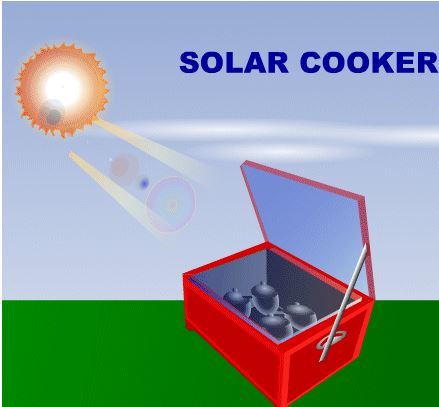
Question : 3 With the help of a diagram, explain the construction and working of a box type solar cooker.
Answer :
The heat absorbing property of black surfaces and the green house effect are utilised in making solar cookers. There are various types of solar cooker out of which, the box type solar cooker is one. The box of the solar cooker is made from non-conducting materials like plastics or fiberglass, with its inner walls painted in black. The walls of the box are made thick with a lining of non-conducting material to prevent loss of heat. Usually, a plane mirror is hinged on the top of the box. The mirror is adjusted in such a manner that it reflects sunlight into the box. The main purpose of the mirror is to increase the effective area for the collection of solar energy. The box is covered with a glass sheet that facilitates retention of heat inside due to green house effect. The temperature inside this type of solar cookers can go from 100 ºC to 140 ºC when they are kept in the sun for two to three hours. This type of cookers can be used to prepare food items that require slow heating, for example, for boiling rice, vegetables or dal. The solar cookers are provided with small containers with their outer surfaces painted in black. Two or three items could be prepared simultaneously by using these containers.
Question : 4 Mention any two differences between a box type and a concentrator type solar heater.
Answer :
Box-type solar heater:
In this type of heater, a plane reflector is used which does not concentrate solar energy at a point.
It produces comparatively low temperature.
Concentrator type solar heater:
In this type of heater a concave reflector or a parabolic reflector is used which concentrates the solar energy in a small region called focus.
It produces high temperature.
Question : 5 Why is it not possible to make use of solar cells to meet all our energy needs? State atleast two reasons to support your answer.
Answer :
(i) The electricity generated by solar cells during the day is stored by using it to change storage batteries. These storage batteries give us direct current, but to operate the various devices, alternating current is required.
(ii) The usage of solar cells becomes expensive, since the direct current given by the storage batteries has to be changed into alternating current using suitable appliances.
Question : 6 Mention any four areas where solar cells are being used as a source of energy.
Answer :
Solar cells are used for street-lighting, for traffic signals, for operating water-pumps and for running radio and television sets in remote areas.
Question : 7 Why can wind energy farms be established only at specific locations? Give reasons to support your answer.
Answer :
Wind energy farms can be established over a big area of land, where sufficient wind is blowing always, because electricity generated by a single wind turbine is quite small, so in order to generate a large amount of electricity, a large number of wind turbines are erected over a big area of land.
Question : 8 It is difficult to use hydrogen as a source of energy, although its calorific value is quite high. Explain.
Answer :
(i) When hydrogen gas is lighted, it burns with an explosion which is very unsafe.
(ii) It is very expensive to produce hydrogen gas by the electrolysis of water because it requires a lot of electricity.
(iii) It is very difficult to store and transport hydrogen gas as it is explosively inflammable.
Hence it is difficult to use hydrogen as a source of energy, though it has high calorific value.
Question : 9 State the forms in which energy stored in the oceans manifests itself. Which one of these is utilized in OTEC systems?
Answer :
The energy from oceans is obtained in three forms:
(i) Tidal energy
(ii) Ocean waves energy and
(iii) Ocean thermal energy
Ocean thermal energy is used in OTEC system.
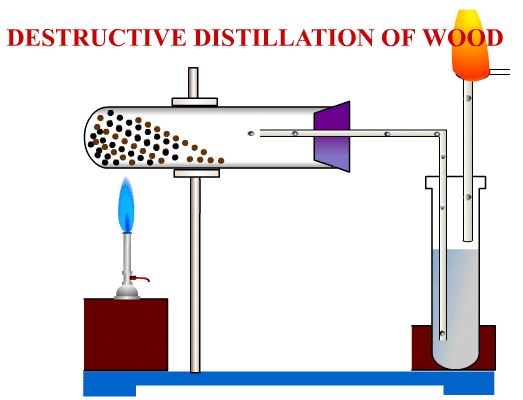
Question : 10 With the help of a diagram, explain the process of destructive distillation of wood.
Answer :
Mddle block 1
Question : 11 Why is charcoal considered a better fuel than wood? What are the disadvantages of converting wood into charcoal?
Answer :
Charcoal is a better fuel than wood because of the following reasons:
(i) Charcoal has better calorific value than wood, i.e., charcoal produces more heat on burning than an equal mass of wood.
(ii) Charcoal does not produce smoke while burning whereas wood produces a lot of smoke on burning and pollutes the air.
(iii) Charcoal is a compact fuel which is easy to handle and convenient to use.
Disadvantages of converting wood into charcoal:
Cutting down of trees in the forests has created the shortage of wood to prepare sufficient charcoal. As a result of this, charcoal has now become expensive fuel. Hence the use of charcoal as a fuel is discouraged so as to prevent deforestation and hence to conserve the ecosystem from the ill effects of deforestation.
Question : 12 Describe the steps involved in obtaining biogas and explain what is meant by anaerobic decomposition.
Answer :
Two types of biogas plants are being used in our country; they are
1. The fixed-dome type
2. The floating gas-holder type
the main raw material used in these plants is animal dung (cow-dung, dung of horse, elephant, goat, etc). Plant wastes like vegetable skins, fruit pulp and human excreta may be added to the animal dung. Biogas is produced by the anaerobic decomposition of animal wastes like animal dung in the presence of water. The decomposition which takes place in the absence of oxygen is called anaerobic decomposition. This decomposition is carried out by anaerobic micro-organisms called anaerobic bacteria in the presence of water but in the absence of oxygen. Animal dung and plant wastes contain a lot of carbon compounds like carbohydrates, proteins and fats. The anaerobic bacteria decompose these carbon compounds to form methane gas, which is the main constituent of bio-gas. Some other gases like carbon dioxide, hydrogen and hydrogen sulphide are also formed.
Question : 13 State the advantages of obtaining biogas from animal dung and bio-wastes.
Answer :
(i) The bio-gas obtained from animal dung and bio-wastes can be used as a smokeless fuel.
(ii) It gives us a clean fuel.
(iii) The spent dung can be used as a manure.
Question : 14 Why are fossils fuels classified as non-renewable sources of energy? What steps should be taken to conserve these sources?
Answer :
Fossil fuels are non-renewable source of energy, because if they are exhausted, it cannot be regenerated in a short time. This is because of the fact that, the fossil fuels which we use today, took millions of years to be formed. The fossil fuels are being fast depleted. To overcome this depletion, we have to conserve energy. We can follow the following simple rules to conserve energy:
(i) Switch off lights and fans when not in use.
(ii) Use solar cookers, heaters, dryers wherever possible.
(iii) Use tube lights which consume less energy instead of incandescent lamp wherever possible.
(vi) Use efficient home appliances and fuel efficient stove.
Question : 15 The heat produced on complete combustion of 10 g of a fuel could raise the temperature of 2 kg of water from 20° C to 70° C. Calculate the calorific value of the fuel, if the specific heat capacity of water was 4.2 J/g ° C. Assume that the heat taken by the container is negligible.
Answer :
Mass of water = 2 kg = 2000 g
Specific heat of water = 4.2 J/g °C
Rise in temperature, t = 70 °C – 20 °C = 50°C
We know that heat produced Q = m × s × t
= 2000 × 4.2 × 50
= 420000 joules
This heat of 420000 joules has been produced by burning 10 g of fuel.
Let us calculate the heat produced by burning 1 g of fuel,
hence
10 g of fuel produce heat = 420000 joules
and 1 g of fuel produce heat = 420000 /10 = 42000 joule.
Thus, the calorific value of the fuel is 42000 joules per gram.
To convert it into kilojoules per gram, we have to divide by 1000,
hence
Calorific value of fuel = 42000/1000 kJ/g = 42 kJ/g.
Question : 16 How much energy will 1 kg mass of wood yield on complete combustion if its calorific value were 15 kJ/g?
Answer :
Calorific value of wood = 15 kJ/g = 15000 J/g
Mass of wood = 1 kg = 1000 g
Therefore heat produced by 1 kg of wood = 15000 × 1000 = 15 × 105 J.
Question : 17 Suppose the average solar energy incident on the green canopy (leaves) of a tree is 108 J per day. The calorific value of the wood obtained from the tree could convert 1% of incident solar energy as wood, how many days will it take to produce 10 kg of wood?
Answer :
Calorific value of wood = 15KJ/g
Conversely the same energy (15KJ) is required to form 1g of wood.
Energy required to form 10Kg of wood = 10 × 1000 × 15 = 15 × 104 KJ of energy
The average solar energy received per day = 108J day-1
But 1% of incident energy that is useful for the formation of wood = (108) / 100 = 106 J day-1
No of days required to form 10kg of wood = (15 x 104 x 103) / 106 = 15 × 10 = 150 days.
Question : 18 State the conditions essential for combustion to take place.
Answer :
The conditions for combustion to take place are:
(i) Presence of a combustible substance.
(ii) Presence of a supporter of combustion like air or oxygen.
(iii) Presence of a combustible substance to its ignition temperature.
Question : 19 Explain how knowledge of the conditions of combustion could help in fire fighting.
Answer :
(i) The combustible substance like furniture, clothes and books, etc., are removed first when fire starts in a room, so that the fire may not spread due to the presence of a large number of combustible substance.
(ii) When the burning clothes of a person are covered with a blanket, the supply of air is cut off and burning stops.
(iii) A wet cloth does not burn because water present in it keeps the temperature of the cloth below its ignition temperature.
Question : 20 What constitutes a source of energy?
Answer :
A resource which can provide adequate amount of energy in a convenient form over a long period of time constitutes a source of energy.
Question : 21 State the two forms in which energy is mainly utilized at our homes.
Answer :
Electrical energy is used for lighting bulbs, tubes and to run household appliances. Heat energy obtained by burning wood, coal, kerosene or cooking gas are used for cooking our food.
Question : 22 Explain why fossils fuels are classified as non-renewable sources of energy.
Answer :
Fossil fuels are present in limited amounts in the earth and they cannot be replaced quickly when exhausted. Hence they are called non-renewable sources.
Question : 23 Name any two renewable sources of energy.
Answer :
(i) Solar energy
(ii) Wind energy.
Question : 24 Why is the use of wood as a fuel not advised although forests can be replenished?
Answer :
Wood produces a lot of smoke on burning and pollutes the air. Hence it is advised not to use it as a fuel.
Question : 25 How much solar energy will be received by 1m2 area in one hour, if the solar constant were 1.4 kilowatt per square metre?
Answer :
One hour = 60 × 60 = 3600 s
Solar constant = 1.4 kW/m2= 1.4 kJ/s/m2
i.e., in 1s, 1m2 area receives energy = 1.4 kJ
So, in 1 hour, i.e., in 3600 s, 1 m2 area receive energy = 1.4 × 3600 kJ = 5040 kJ.
Question : 26 What is the range of the wavelength of electromagnetic waves that constitutes visible radiation?
Answer :
The wavelength range for the visible radiation is 400 nm in violet to 700 nm in red.
Question : 27 Name the component of sunlight that mainly carries heat with it.
Answer :
Infrared rays carries the sensation of heat in sunlight.
Question : 28 Name any two components of solar radiation that are not visible to us.
Answer :
Ultraviolet rays and infrared rays.
Question : 29 Name the type of radiation emitted by a hot electric iron?
Answer :
Infrared radiation.
Question : 30 State any two activities from our daily life in which solar energy is utilized.
Answer :
(i) Solar energy is used for drying clothes.
(ii) Solar energy is used for the preservation of fruits, vegetables and fish, etc., by the process of sun-drying.
Question : 31 Wavelength of radiation incident on a surface is 850 nm. Will the surface become visible when exposed to this radiation?
Answer :
The surface is not visible since the radiation incident is more than visible range, i.e., the incident radiation is an infrared radiation which is invisible.
Question : 32 Name any two materials that are used for making solar cells.
Answer :
Solar cells are made from semiconductor materials like silicon and gallium.
Question : 33 What prevents us in making use of solar cell panels to meet all our domestic needs of electricity?
Answer :
The electricity generated by solar cell panels during the day is stored by using it to charge storage batteries. These storage batteries give us direct current. But to operate the various devices, alternating current is required. So, the direct current given by storage batteries has to be changed into alternating current by using suitable appliances before it can be used to run various devices. This increases the cost of using solar panels as the source of electricity.
Question : 34 Explain the principle behind the working of a windmill.
Answer :
When the blowing wind strikes across the blades of wind-mill, it exerts a force on them due to which the blades of the wind-mill start rotating. As long as the wind is blowing, the blades of wind-mill keep on rotating continuously. The rotational motion of the blades of the wind-mill can be used to drive a large number of machines like water-pumps, flour mills and electric generators.
Question : 35 What is the minimum wind velocity required for obtaining useful energy with a windmill?
Answer :
The minimum wind velocity required for obtaining useful energy is 15 km/h.
Question : 36 Explain how the energy of flowing water is related to solar energy.
Answer :
The energy of flowing water is an indirect source of solar energy. The heat of solar energy evaporates water from the oceans and the surface of earth. The water vapour thus formed rise high in the atmosphere, get cooled and fall back to the earth in the form of rain and snow. This rain water and the water formed by the melting of snow then flows rapidly in the rivers and provides us energy.
Question : 37 Mention any two advantages and disadvantages of producing hydroelectricity by building dams on rivers.
Answer :
Advantages
(i) The use of water energy does not cause any pollution.
(ii) It is a cheap and renewable source of electricity, which will never get exhausted.
Disadvantages
(i) The construction of dams on rivers results in to a variety of ecological changes in the downstream area of the river.
(ii) The soil in the downstream area becomes poor in quality because of the lack of annual floods to deposit nutrient rich slit on the banks of the river.
Question : 38 Name the process that converts solar energy into chemical energy in nature.
Answer :
Photosynthesis.
Question : 39 Mention any two situations where muscular energy of animals is utilized to do mechanical work.
Answer :
(i) To burn the dry bio-mass, like cattle dung, directly to produce heat.
(ii) To convert the bio-mass into more useful fuels and then use these fuels for heating purposes.
Question : 40Why is burning firewood in traditional chulhas considered disadvantageous?
Answer :
(i) Most of the heat produced by burning the fuels in traditional chulhas is lost to the surroundings, only 8% of the heat is utilized in cooking food, etc.
(ii) It produces lot of smoke due to the incomplete combustion of wood, etc.
Question : 41 Name the main constituent of biogas.
Answer :
Methane is the main constituent of biogas.
Question : 42 Give two examples of fossil fuels.
Answer :
Coal and Petroleum.
Question : 43 Name any three varieties of coal found in nature.
Answer :
Anthracite, Bituminous and Lignite.
Question : 44 How is petroleum gas obtained? Name the gas that is its main constituent.
Answer :
Petroleum gas is obtained as a by-product in oil refineries from the fractional distillation of petroleum. It is also produced by the cracking of petrol. The main constituent of petroleum gas is butane.
Question : 45 Name any two components obtained by fractional distillation of petroleum that are not used as a fuel.
Answer :
Asphalt and lubricating oil.
Question : 46 Write the full name for LPG and CNG.
Answer :
LPG – Liquefied Petroleum Gas
CNG – Compressed Natural Gas.
Question : 47 Name three characteristics of a fuel that determines its quality.
Answer :
The three characteristics of a fuel that determines its quality are:
(i) It should burn easily.
(ii) It should cause least pollution in air.
(iii) It should be easy to store and should not produce any hazards during transportation.
Question : 48 The heat produced by burning of cow dung cake of mass 210 g raised the temperature of 50 g of water by 2°C. Assuming that all the heat was utilized for heating water whose specific heat capacity is 4.2 J/g °C, calculate the calorific value of the dung cake.
Answer :
Mass of cow dung = 210 g
Mass of water, m = 50 g
Specific heat of water, s = 4.2 J/g/°C
Rise in temperature, t = 2 °C
Heat produced Q = m × s × t = 50 × 4.2 × 2 = 420 Joules
Calorific value of cow dung = 420/210 = 2 J/g.
Question : 49 Explain why is it difficult to burn a wet piece of wood.
Answer :
It is difficult to burn a wet piece of wood because water present in it keeps the temperature of wood below its ignition temperature.
Question : 50 Pouring dry sand over fire helps to contain it. Explain why?
Answer :
When sand is poured over fire, the supply of air is cut off and the fire stops. When the supporter of combustion is cut off, then the combustion also stops. Hence we say that pouring dry sand over fire helps to contain it.
Question : 51 What is the ultimate source of almost all our sources of energy?
Answer :
The energy that the earth receives from the sun, in the form of heat and light, is the ultimate source of almost all our source of energy.
Question : 52 Define net energy or useful energy with an example.
Answer :
The difference between the output energy and the input energy is usually referred to as the net energy or useful energy. For example, when we use fuel, say coal or wood or kerosene, we have to provide some initial heat to ignite it, which in this case, is the input. The difference between the heat given off by the burning fuel i.e. the output and the input, will be the useful energy in this case.
Question : 53 How does technology help in the transformation of energy?
Answer :
Technology provides the means to transform the energy of different sources into either a fuel or electricity
Question : 54 How is bio gas produced?
Answer :
Bio-gas is produced by the anaerobic degradation of bio-mass in the presence of water but in the absence of air.
Question : 55 Why is sun called the ultimate source of fossil fuels?
Answer :
Fossil fuels are formed by plants and animals in the course of millions of years. Fossil fuels are the energy rich compounds of carbon which were originally made by plants with the help of sun’s energy (by photosynthesis) when they (plants) were alive millions of years ago.
Question : 56 Why can a match-stick light a splinter of wood but not a log of wood?
Answer :
The ignition temperature of a splinter of wood is much lower than that of a log of wood. Thus, a match-stick can produce sufficient heat to reach the ignition temperature of a splinter of wood and make it burn while a match-stick cannot produce sufficient heat to reach the ignition temperature of log of wood and thus cannot cause it burning.
Question : 57 What is combustion? Give the conditions necessary for combustion.
Answer :
The process of burning of a substance in the presence of air (oxygen) to produce heat and light is known as combustion.
Conditions required for combustion are:
(i) presence of a combustible substance.
(ii) presence of a supporter of combustion (oxygen).
(iii) heating the combustible substance to its ignition temperature.
Question : 58 Give the uses of Natural gas.
Answer :
Natural gas is used
(i) as a domestic and industrial fuel.
(ii) in thermal power plants to generate electricity.
(iii) as a fuel in vehicles like buses, cars, autos etc.
(iv) in the fertilizer industry as a source of hydrogen gas.
(v) in the tyre industry as a source of carbon
Question : 59 Wood is a renewable source of energy, but the use of wood as a fuel is not a wise decision. Explain.
Answer :
Wood is a renewable source of energy. It is obtained by cutting trees. A newly planted sapling usually takes more than 15 years to grow and mature into a tree. Therefore replenishment of cut down trees takes a very long time. Cutting down of trees causes the depletion of forests leading to an imbalance in nature. Due to unsuitable air and the above reasons, usage of wood as a source of energy is not a wise decision.
Question : 60 What is meant by solar heating device?
Answer :
A device, which utilises sun’s energy, is called a solar heating device. Example: Solar Cooker, Solar Heater, etc.
Question : 61 Solar energy can be harnessed directly as well as indirectly. Give two examples of each type.
Answer :
(i) Direct utilization of solar energy
The direct utilization of solar energy can be done either by collecting it as heat or by converting it directly into electricity.
Examples: Solar cooker and solar water heater uses this type of utilization of solar energy.
(ii) Indirect utilization of solar energy
The indirect utilization of solar energy can be done by converting it into chemical energy like the bio-mass of plants. The other indirect ways of utilizing the solar energy are: Harnessing the energy of the wind and utilization of energy of the sea-waves.
Question : 62 Explain why a solar cooker box is painted black from the inside?
Answer :
A black coloured surface absorbs much more heat when compared to a white coloured surface. Hence in the designing of solar heating devices, black painted surfaces are used so that they may absorb the maximum amount of heat from the sunlight or sunshine. In a box-type solar cooker, the inner walls and the bottom of the cooker are painted black to maximize absorption of heat and to minimize heat loss due to reflection. A metal sheet, which is painted black, can be considered as the simplest solar heating device because on keeping in sunshine, it absorbs a lot of sunrays and becomes quite hot. However, after becoming hot, a black surface itself starts radiating the absorbed heat. So, after some time its temperature starts decreasing and tends to become equal to the temperature of its surroundings.
Question : 63 Explain why the property of glass in trapping heat is called greenhouse effect?
Answer :
The property of glass is made use of in constructing green-houses used for protecting green plants in very cold climate. A greenhouse is a house-like structure made entirely of glass. The plants to be protected from the cold weather are placed inside this glass house. The glass roof and glass walls of the green-house allow the heat and light of the sun to pass through them and go inside it. They do not allow the inside heat to go out. In this way, heat gets trapped in the glass house due to which it becomes quite warm inside.
Question : 64 How are solar cells made?
Answer :
Solar cells are made from semi-conductor materials like silicon and gallium. To make solar cells, the wafers of semiconductor materials containing impurities are arranged in such a way that when light falls on them, a potential difference is produced between the two regions of the semi-conductor wafers. This potential difference then produces electric current. The potential difference produced by a single solar cell of 4 square centimeter size is about 0.4 volt to 0.5 volt and generates a current of 60 milliamperes.
Question : 65 What causes the wind to blow?
Answer :
Solar energy is responsible for the blowing of the wind. The sunrays fall on the whole earth. But the intensity of sunrays is much more stronger near the equator of the earth than in the polar regions. Due to more intense sun-heat, the air near the surface of the earth in equatorial regions becomes quite hot. This hot air, being lighter, rises upwards. The cooler air from the polar regions of the earth starts flowing towards the equatorial regions of the earth to fill the space vacated by the hot rising air. In this way, air flows from the higher pressure regions to the low pressure regions of the earth. This flow of air from one place to another constitutes wind.
Question : 66 Explain the transformation of energy taking place in the generation of hydroelectricity.
Answer :
The water stored in a high dam has potential energy in it. When the dam water is allowed to fall down, the potential energy of stored water is converted into the kinetic energy of flowing water. When this fast moving water falls on the water turbine, its kinetic energy is transferred to the water turbine. By gaining the kinetic energy, the water turbine starts rotating rapidly and also rotates the armature of the generator fixed on its shaft. The armature then converts the kinetic energy into electrical energy.
Question : 67 Explain how tidal energy can be used for generating electricity.
Answer :
The rise of ocean water due to the attraction of the moon is called ‘high tide’ whereas the fall of ocean water is called ‘low tide’. The tidal water in the oceans builds up and recedes twice a day. The enormous movement of water between the high tides and low tides provides a very large source of energy in the coastal areas of the world. The tidal energy can be harnessed by constructing a tidal barrage or tidal dam. During high tide,when the level of water in the sea is high, sea-water flows into the reservoir of the barrage and turns the turbines. The turbines then turn the generators to produce electricity. During the low tide, when the level of seawater is low, the seawater stored in the barrage reservoir is allowed to flow out into the sea. This flowing water also turns the turbines and generates electricity. Thus, as seawater flows in and out of the tidal barrage during high and low tides, it turns the turbines to generate electricity.
Question : 68 State two advantages and two disadvantages of geothermal energy.
Answer :
Advantages
(i) It is economical to use because the cost of electricity produced by using geothermal energy is almost half of that produced from conventional energy sources.
(ii) It does not cause any pollution.
Disadvantages
(i) It is not available everywhere, it is available only in those areas where there are hot rocks near the earth’s surface.
(ii) Deep drilling in the earth to obtain geothermal energy is technically very difficult and expensive.
Question : 69 Why is it not good to burn animal dung directly as a fuel?
Answer :
It is not good to burn animal dung directly as a fuel because
(i) Animal dung contains important elements like nitrogen and phosphorus which are required by the soil to support crops. So, burning of dung in the form of dung cakes, destroys the useful nutrients which can otherwise be use as a manure in agriculture.
(ii) They produce a lot of smoke on burning which causes air pollution.
(iii) They do not burn completely, they produce a lot of ash as residue.
(iv) They have a low calorific value.
Question : 70 Name the substance from which alcohol is manufactured on a large scale. What is this process known as?
Answer :
Alcohol is made from sugar. It is manufactured in large quantities by fermentation of sugar.
Question : 71 What are the drawbacks of wind energy?
Answer :
The power which is generated using wind energy is not much efficient and also we cant get the power generation all the times.
Question : 72 How is tidal energy harnessed?
Answer :
High tides of sea, which can be used to generate power by using the turbine. A turbine converts mechanical energy into electrical energy.
Question : 73 Why is charcoal a better fuel than wood?
Answer :
Charcoal is a better fuel than wood, because it has high thermal capacity than wood.
Question : 74 How is biogas prepared?
Answer :
When wood is compressed for a number of years inside the earth, it becomes charcoal. By using the charcoal, we can produce the biogas. Methane is the known biogas.
Question : 75 Explain the function of turbine.
Answer :
Turbine is one which converts the mechanical energy into electrical energy. Hydroelectric power is a generated using turbine which converts air pressure into electrical energy using rotation of turbines and also flow of water through turbines converts mechanical energy into electrical energy.
Question : 76 Give some examples for renewable and non-renewable sources?
Answer :
Solar energy, wind energy are the examples of renewable sources. Coal, petroleum, fuel are the examples of non-renewable sources.
Question : 77 Which is the known biogas?
Answer :
Methane is the known biogas.
Question : 78 Heat produced on burning 5gm of a fuel raises the temperature of 1 kg of H2O from 20°C – 60°C. If the specific heat of H2O is 4.2J/g°C, calculate the calorific value of the fuel?
Answer :
Formula: mst = 5 gm x 4.2 x 40 = 840.
Question : 79 Explain greenhouse effect.
Answer :
The phenomenon whereby the earth’s atmosphere traps solar radiation, caused by the presence in the atmosphere of gases such as carbon dioxide, water vapor, and methane that allow incoming sunlight to pass through but absorb heat radiated back from the earth’s surface.
Question : 80 Why does the interior of a car parked in the sun become hot?
Answer :
The solar radiation which is absorbed by the car is the basis for the green house effect.
Question : 81 What is solar constant?
Answer :
The Solar Radiation that falls on an area above the atmosphere at a vertical angle: s = 1.37 kW / m2.
In space, solar radiation is practically constant; on earth it varies with the time of day and year as well as with the latitude and weather. The maximum value on earth is between 0.8 and 1.0 kW / m2. In Germany, the average annual amount of insolation varies between 950 and 1100 kWh/m2, depending on the region.
Question : 82 What radiations are converted to electricity in a solar cell? What are they used?
Answer :
Solar radiations are converted into electricity in solar cell which is used in traffic signal lights, etc.
Question : 83 Name any two renewable sources of energy.
Answer :
Solar energy and wind energy.
Question : 84 Explain about calorific value of fuel.
Answer :
Heat energy is measured in units of joules or calories (1calorie = 4.18 joules). The heat generated by fuels when they burn in joules or calories measures quality of fuels. All fuels do not burn efficiently. Thus there are fuels that produce more heat than the others are. This can be distinguished in terms of number of joules or calories that they generate on burning.
Question : 85 Define ignition temp.Which has lower ignition temperature, kerosene or LPG. Why?
Answer :
When any substance tends to burn for a particular temperature it is called the ignition temperature for that particular substance.
Question : 86 Explain about solar collector.
Answer :
Solar collector is a form of collector which collects solar energy and transforms the solar energy to the form which can be utilized according to the system.
Question : 87 What are the characteristics of source of energy?
Answer :
Characteristics are generally classified in to renewable sources of energy and non-renewable sources of energy, which is used in heating, producing power, etc.
Question : 88 How is electricity produced from thermal power plants?
Answer :
In thermal power plants, heat is converted into steam energy which runs the turbine to get electrical energy.
Question : 89 Give the peculiar property of glass sheet?
Answer :
A glass sheet transmits solar radiation into it as a semiconductor.
Question : 90 What are the important factors/parts in constructing a solar cooker? Give its importance.
Answer :
Black coated sheets, glass plates, vessel, etc.
Question : 91 Give one main difference between solar cooker and solar concentrator.
Answer :
In solar cooker, solar radiation spreads at all the points, whereas in solar concentrator it is concentrated at a particular point.
Question : 92 Explain the construction of a solar cell. Give the uses of solar cell.
Answer :
Solar cell consists of a black plate, which absorbs the solar radiation and converts this solar radiation in to electrical energy by the process of photoelectric effect. It is used in traffic signals, etc.
Question : 93 How is harnessing hydroelectric energy done on a small scale?
Answer :
By using the flow of water in rivers and dams, hydroelectricity is demonstrated and power is generated.
Question : 94 Explain about hydroelectricity.
Answer :
It is the conversion of flow of water in to electric power. The basic process is electromagnetic induction, which converts mechanical energy into electrical energy.
Question : 95 How is biogas energy better than any energy?
Answer :
Biogas energy is better than any other energy, because it is not harmful at any cause and it is pollution free.
Question : 96 Why are hydrogen and alcohol not commercial fuel?
Answer :
When alcohol is used as a fuel, then the byproduct is carbon dioxide and carbon monoxide. This is the reason that hydrogen and alcohol are not commercial fuel.
Question : 97 Explain wind energy.
Answer :
Wind energy is the conversion of air pressure into electric power. The high pressure wind runs the wind mill, which in turn produces electric power.
Question : 98 What are the qualities in choosing a good fuel?
Answer :
Must be highly efficient, low in cost and durable.
Question : 99 What are the limitations of harnessing wind energy? Where is the largest wind energy farm in India?
Answer :
Windmill gives high efficiency only in wind seasons. Wind energy is the conversion of air pressure into electric power. The high-pressure wind runs the windmill, which in turn produces electric power. We have the wind mills in northern part of our country which produces high power.
Question : 100 Draw a neat diagram of the box type solar cooker. Label it and explain the function of each part.
Answer :
A solar cooker is like a hot box, in which we can cook our food without any cooking gas or kerosene, electricity, coal or wood. We do not need to spend even a single paisa on fuel. This cooker works with the solar energy, which is available free. In a solar cooker we can boil, bake and roast, and in a cooker for domestic use, we can cook food for four to five persons. Bigger size solar cookers are also available for cooking food upto 15 persons.
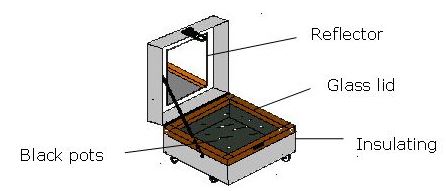
A solar cooker consists of a well-insulated box for storing energy. To increase the absorption of solar radiation, the inside of the box is painted back.
Glass Lid
The insulated box has a glazing glass surface for collecting energy. The solar cooker absorbs the Sun’s radiant energy through this glass lid.
Reflector
The insulated box has a reflector, which is an ordinary mirror used to reflect sunlight into the box. This reflector helps to track the movement of the sun, focusing sunlight and therefore concentrating the heat energy inside the box.
Black Pots
Solar absorption is also increased by using dark-coloured pots for cooking. The vessels that are painted in black are placed inside the box with the food to be cooked.
Question : 101 Why is the sun very hot than any other hot body and how does it continously emit solar energy? Justify.
Answer :
Due to nuclear fusion, there is a continuous emission of solar energy.
Question : 102 Give the purpose of mirror and glass sheet in solar cooker.
Answer :
In solar cooker glass sheet acts as a transparent medium which allows light into the medium. Mirror reflects the light which emerges from the cooker.
Question : 103 Why are solar cells not used effectively?
Answer :
High expensive, not re-usable. Hence it is not used effectively.
Question : 104 Give the limitations in using commercially wood as fuel, over windmills.
Answer :
Basic commercial fuel used is wood, because of its abundance in existence. Another fact is it is non-renewable but windmill energy is a renewable source of energy.
Question : 105 A student constructed a box type solar cooker. He found that it is not working efficiently. What could this be due to? Give any four possible mistakes that he could have made?
Answer :
The transparency of the glass plate must be checked.
The reflectance of the mirror is to be checked.
The black coating must be coated effectively.
The solar cooker must be placed in a way such that it faces the sun’s radiation.
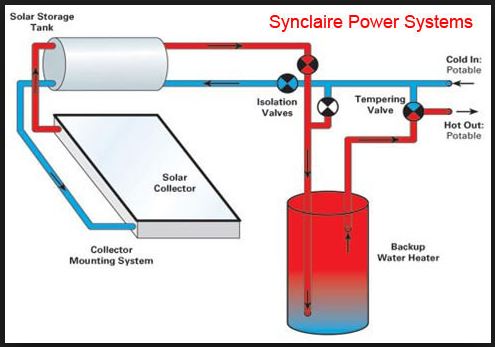
Question : 106 What are the advantages of using solar water heater? Draw a labeled schematic diagram for a solar water heater.
Answer :
A Solar Water Heater (SWH) is a device that uses solar energy to heat water. Solar Water Heater have several advantages over conventional water heating systems. For consumers, they save electrical energy, save interior space (because they are usually located on rooftops,) and eliminate the risk of accidents in bathrooms due to electrical water heating equipment, They require little or no care and attention while providing hot water for about 300 days in a year in most parts of India. For society at large, they reduce the need for fossil fuels for electrical generation and for fuels such as firewood, coal, furnace oil, etc, that are used in domestic, commercial and industrial boilers. Thereby, they also reduce degradation of the environment
Question : 107 Define solar constant.
Answer :
The amount of solar energy form the sun which incident on the earth per square metre is called solar constant.
Question : 108 What is the main basic cause for winds to blow? Compare wind power and power of water flow in respect of generating mechanical and electrical energies.
Answer :
The main basic cause for the winds to blow is the difference in temperature of the atmosphere, which makes the air to get high dense and low dense and in turn flow from one part to other. When comparing wind power and hydroelectricity, it seems that hydroelectricity is better when compared with wind energy.
Question : 109 Write two limitations of wind mill.
Answer :
An estimated 1% to 3% of energy from the Sun that hits the earth is converted into wind energy. This is about 50 to 100 times more energy than is converted into biomass by all the plants on Earth through photosynthesis. Most of this wind energy can be found at high altitudes where continuous wind speeds of over 160 km/h (100 mph) occur. Eventually, the wind energy is converted through friction into diffuse heat throughout the Earth’s surface and atmosphere.
The origin of wind is simple. The Earth is unevenly heated by the sun resulting in the poles receiving less energy from the sun than the equator does. Also the dry land heats up (and cools down) more quickly than the seas do. The differential heating powers a global atmospheric convection system reaching from the Earth’s surface to the stratosphere which acts as a virtual ceiling.
Question : 110 Explain wind power, the principle behind wind mill and its uses.
Answer :
Wind power is the conversion of wind energy into more useful forms, usually electricity using wind turbines. In 2005, worldwide capacity of wind-powered generators was 58,982 megawatts; although it currently produces less than 1% of world-wide electricity use, it accounts for approximately 25% of electricity use in Denmark, 9% in Spain, and 6% in Germany. Globally, wind power generation more than quadrupled between 1999 and 2005.
Most modern wind power is generated in the form of electricity by converting the rotation of turbine blades into electrical current by means of an electrical generator. In windmills (a much older technology) wind energy is used to turn mechanical machinery to do physical work, like crushing grain or pumping water. Wind power is used in large scale wind farms for national electrical grids as well as in small individual turbines for providing electricity to rural residences or grid-isolated locations. Wind energy is ample, renewable, widely distributed, clean, and mitigates the greenhouse effect if used to replace fossil-fuel-derived electricity.
Question : 111 (a) What is a solar water heater?
(b) Mention one advantage and one disadvantage of harnessing solar energy.
Answer :
(a) A Solar Water Heater (SWH) is a device that uses solar energy to heat water.
(b) Solar Water Heater have several advantages over conventional water heating systems. For consumers, they save electrical energy, save interior space (because they are usually located on rooftops) and eliminate the risk of accidents in bathrooms due to electrical water heating equipment, They require little or no care and attention while providing hot water for about 300 days in a year in most parts of India. For society at large, they reduce the need for fossil fuels for electrical generation and for fuels such as firewood, coal, furnace oil, etc, that are used in domestic, commercial and industrial boilers. Thereby, they also reduce degradation of the environment.
Question : 112 Draw the two common designs of solar cookers.
Answer :
Box type solar heater and Spherical type solar heater
Question : 113 What is the meaning for gobar?
Answer :
Gobar means animal dung in Hindi.