

Answer :
| S.No. | Punched holed figures | The axes of symmetry |
|---|---|---|
| A. |  |  |
| B. |  | 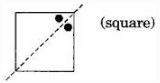 |
| C. |  | 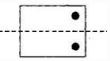 |
| D. |  |  |
| E. |  |  |
| F. |  |  |
| G. |  |  |
| H. |  |  |
| I. |  |  |
| J. |  |  |
| K. |  | 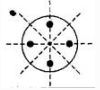 |
| L. |  |  |
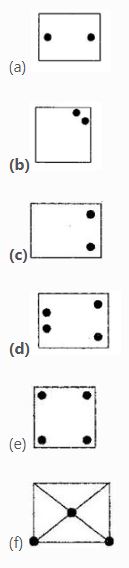
Answer :
| S.No. | Line(s) of symmetry | Other holes on figures |
|---|---|---|
| A. |  |  |
| B. |  |  |
| C. |  |  |
| D. |  |  |
| E. |  | 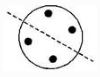 |
Question: 3. In the following figures, the mirror line (i.e., the line of symmetry) is given as a dotted line. Complete each figure performing reflection in the dotted (mirror) line. (You might perhaps place a mirror along the dotted line and look into the mirror for the image).
Are you able to recall the name of the figure you complete?

Answer :
| S.No. | Question figures | Complete figures | Names of the figure |
|---|---|---|---|
| A. |  |  | Square |
| B. |  |  | Triangle |
| C. |  |  | Rhombus |
| D. |  |  | Circle |
| E. |  |  | Pentagon |
| F. |  |  | Octagon |
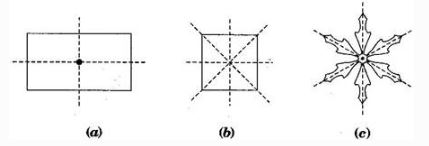
Question: 4. The following figures have more than one line of symmetry. Such figures are said to have multiple lines of symmetry:
Answer :
| S.No. | Problem Figures | Line(s) of symmetry |
|---|---|---|
| A. |  |  |
| B. |  |  |
| C. |  |  |
| D. |  |  |
| E. |  |  |
| F. |  |  |
| G. |  |  |
| H. | 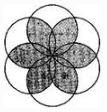 |  |
Question: 5. Copy the figure given here:


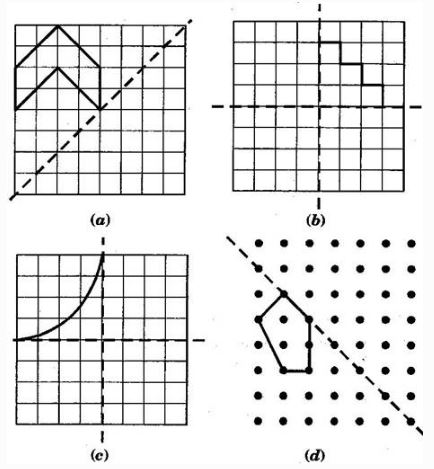
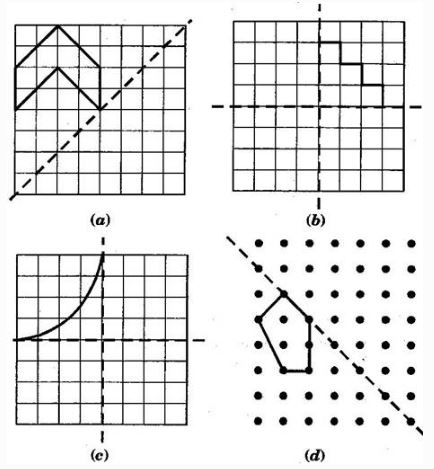
Question: 7. State the number of lines of symmetry for the following figures:
(a) An equilateral triangle (b) An isosceles triangle (c) A scalene triangle
(d) A square (e) A rectangle (f) A rhombus
(g) A parallelogram (h) A quadrilateral (i) A regular hexagon
(j) A circle
Answer :
| S.No. | Figure’s name | Diagram with symmetry | Number of lines |
|---|---|---|---|
| A. | Equilateral triangle |  | 3 |
| B. | Isosceles triangle |  | 1 |
| C. | Scalene triangle |  | 0 |
| D. | Square | 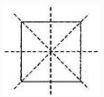 | 4 |
| E. | Rectangle |  | 2 |
| F. | Rhombus |  | 2 |
| G. | Parallelogram |  | 0 |
| H. | Quadrilateral | 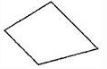 | 0 |
| I. | Regular Hexagon |  | 6 |
| J. | Circle | 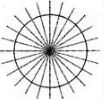 | Infinite |
Question: 8. What letters of the English alphabet have reflectional symmetry (i.e., symmetry related to mirror reflection) about:
- a vertical mirror
- a horizontal mirror
- both horizontal and vertical mirrors
Answer :
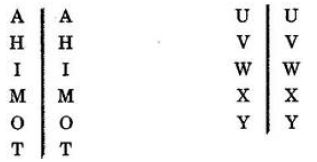
(a) Vertical mirror – A, H, I, M, O, T, U, V, W, X and Y
mirror mirror